





















Jerusalem, 3 June, 2025 (TPS-IL) — In a groundbreaking development, Israeli and German scientists have built an MRI device capable of resolving features as small as a billionth of a meter — a scale fine enough to image the individual atoms within a single molecule. The breakthrough marks the first time that magnetic resonance imaging has reached nanometer-level resolution under room-temperature conditions.
Conventional hospital MRI machines operate at a resolution of about 0.1 millimeters—sufficient to image the human body in slices, but far too coarse to visualize molecular structures. Previous efforts to shrink MRI to the nanoscale have relied on extreme conditions, such as cryogenic temperatures, or lacked the sensitivity and resolution needed to distinguish individual atoms.
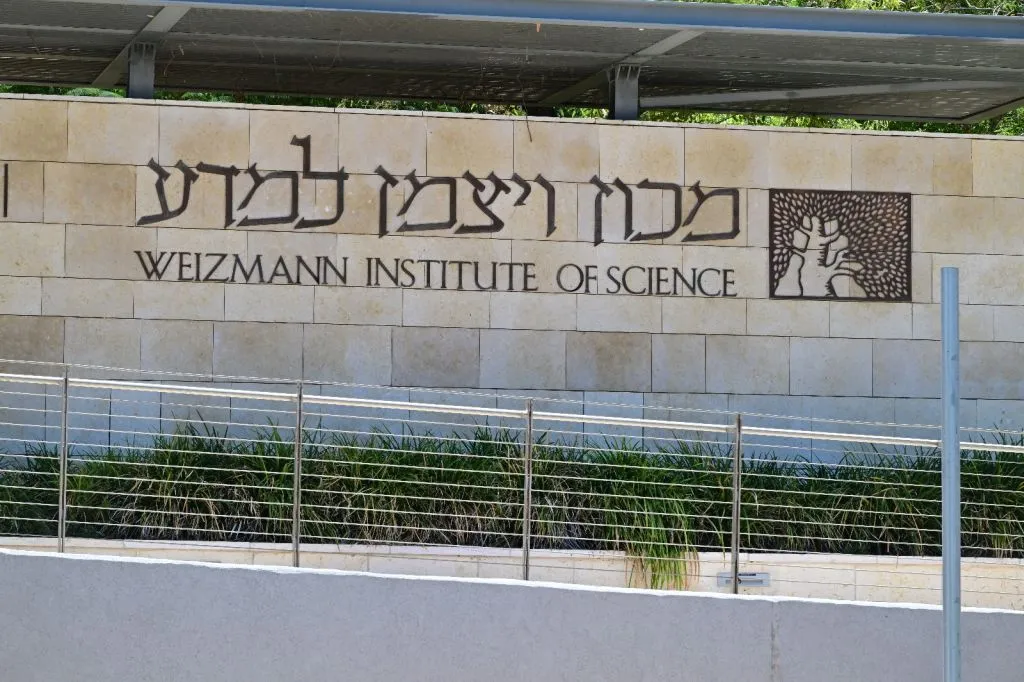
The breakthrough, led by doctoral student Liora Shane Lubomirsky in the lab of Dr. Amit Finkler of the Weizmann Institute of Science, was published in the peer-reviewed Communications Physics journal.
“This device gives us the power to resolve the structure of single molecules, something that was simply not possible before,” said Finkler. “It’s not just an improvement — it’s a redefinition of what MRI can do.”
Also participating in the research were Dr. Rainer Stohr and Dr. Andrei Denisenko from the University of Stuttgart in Germany, and Dr. Yarden Mazor from Tel Aviv University.
To overcome barriers, the scientists combined several innovations. First, they developed a new kind of magnetic field generator. Using a gold conductor shaped in a herringbone pattern atop a quartz tip, the device produces an exceptionally steep magnetic gradient when an electric current is applied. This gradient — 1,000 Tesla per meter, compared to just 0.1 Tesla per meter in standard MRI machines — is 10,000 times stronger, allowing the device to distinguish between atoms that are just billionths of a meter apart.
“The key wasn’t increasing the absolute strength of the magnetic field, but increasing how sharply it changes with distance,” explained Finkler. “That gradient lets us assign a unique resonant frequency to each atom, even when they’re extremely close together.”
The team also made a significant advance in the use of nitrogen-vacancy (NV) centers in synthetic diamond, which serves as ultra-sensitive quantum sensors. Previously, NV centers could detect the presence of nearby atoms but couldn’t distinguish between them — they just averaged the signal. The new magnetic gradient changes that, effectively giving each atom a unique ‘signature’ that the NV center can read.
“Before, we couldn’t separate signals from different hydrogen atoms in a molecule,” said Lubomirsky. “Now, each hydrogen atom appears at a distinct frequency based on its position, allowing us to reconstruct a high-resolution image of the molecule.”
Another novel aspect of the system is that the magnetic field is electronically controlled and switchable. Because the field is created by an electric current rather than a fixed magnet, it can be turned on and off in just 0.6 microseconds. This on-demand control reduces interference during scanning and makes it possible to perform more precise measurements.
Importantly, the system works at room temperature, unlike many competing methods that require freezing temperatures. “A nanoMRI device using the method we proposed will be able to examine materials in the same conditions they’re used in the real world,” said Finkler. “That’s a huge step forward for both fundamental science and industrial applications.”
The implications are especially promising for the pharmaceutical and materials industries. Today, magnetic resonance techniques are already used to verify the purity and composition of drugs, but only in bulk samples. The new nanoMRI could allow researchers to test single molecules, greatly reducing sample requirements and accelerating development timelines.
In the pharmaceutical industry, scanning individual molecules allows researchers to verify the precise structure, arrangement, and purity of a medicine’s active ingredients.
For advanced materials such as superconductors, catalysts, or nanomaterials, understanding how individual atoms are arranged is critical. The device enables structural verification at the atomic level at an unprecedented level of detail.
Moreover, the ability to detect and distinguish single molecules makes this technology promising for detecting trace compounds, such as explosives, drugs, or toxins, in forensic or security applications.
“This is the beginning of a new chapter in molecular imaging,” said Finkler. “We now have a path toward mapping matter at the atomic scale—quickly, cleanly, and at room temperature.”